
Behind the Results: How PURE Laboratories Achieves Five and Six Nines Purity

Achieving 99.999% or 99.9999% purity isn't just a matter of having the right instrumentation. It's the result of hundreds of small, deliberate decisions made every single day — in how samples are prepared, how labs are designed, how contamination is prevented, and how problems are diagnosed when results don't look right. In the second installment of PURE Laboratories' appearance on Bench Boost, the official podcast of Inorganic Ventures, General Manager Dave Neville and IV Labs Vice Chairman and PURE founder Erik Miller gave host Mike Booth an inside look at the analytical rigor behind PURE's materials.
From Production Floor to QC: How a Sample Gets Tested
Every material that leaves PURE Laboratories — whether a starting material or a finished good — goes through a carefully controlled testing process before it ever reaches a customer. Dave walked through what that looks like in practice.
It starts with homogeneity. Before a sample is handed off to the QC team, it's thoroughly blended to ensure consistency throughout the lot. For larger batches, multiple samples are pulled to verify that uniformity holds across the full quantity. From there, PURE's QC team calibrates the ICP using Inorganic Ventures' CMS standards, typically in blends ranging from 0.1 to 1 ppm in a 2% nitric acid matrix — though the matrix can be adjusted to HCl, HF, or other chemistries depending on the material.
Solutions are typically run at 1% to 3% concentration, a range that allows the team to clearly detect impurities down to 1–30 ppm — the window that matters most when targeting five nines purity or better. After the ICP run, QC reviews the data for any drift, shifts, or outliers before compiling results and moving on to assay, which may involve EDTA titrations, redox titrations, or gravimetric analysis depending on the compound.
When the Sample Is the Problem
Most labs focus on instrument performance when results go sideways. At PURE, the challenge is sometimes more fundamental — the physical properties of the material itself.
"Anything that has really low solubility will give us more difficulties," Dave explained, "especially if we're trying to see really low PPM values, because we obviously can't get it into the same solution concentration." When that happens, the team adjusts — dropping to lower solution percentages, running multiple dilutions, or cross-checking results on an AA or alternative method to confirm whether an impurity is genuinely present.
It's a reflection of how broad PURE's catalog actually is. Running nearly the full gamut of the periodic table means the team regularly encounters materials with unusual behavior — and has built the experience to work through it.
Diagnosing the Problem: Sample Prep or Instrumentation?
When an unusual result appears, the first question is always the same: is it the sample, or is it the instrument? Dave described PURE's systematic approach to finding the answer.
The team starts by ruling out cross-contamination — thoroughly cleaning glassware, checking whether a recently processed material with the same impurity could have carried over, and running a second sample to confirm the first result. If the number holds, they work backward through the production process to identify the source. If the ICP itself is behaving unusually, the team disassembles and cleans the system — replacing the spray chamber, glassware, fittings, and lines — before determining whether the issue is truly instrumental or whether the impurity is in fact present in the material.
"Pretty much doing a lot of cleaning and just double-checking ourselves," Dave summarized. When instrument issues can't be resolved internally, the team escalates to the manufacturer — but the default assumption is always methodical troubleshooting first.
Building a Lab That Can Actually Scale
Erik Miller has spent decades not only running high-purity labs, but helping others design them. When Mike asked what he considers non-negotiable in a new lab setup, Erik's answers were shaped by hard-won experience watching well-intentioned labs outgrow themselves too quickly.
Scalability tops the list. Many companies start small out of necessity but underestimate how fast growth can outpace their space. Erik's advice: plan for where you'll be in five to ten years, not just where you are today. That means leaving room for equipment expansion and, where possible, favoring open floor plans over smaller segmented rooms — which can create safety concerns, limit workflow efficiency, and reduce the overall usability of a space over time.
Power infrastructure is another non-negotiable that labs consistently overlook. Modern analytical instruments are power-hungry, and new equipment only adds to the load. Building in capacity now is far less expensive than retrofitting later — and with facility costs continuing to rise, the math on planning ahead only gets more favorable over time.
The Real Secret to Low Detection Limits
Perhaps the most valuable insight from the conversation came when Erik addressed a misconception he sees repeatedly in newer labs: the belief that achieving ultra-low detection limits is primarily an instrumentation problem.
"One of the biggest misconceptions is that labs underestimate how much attention to detail really matters when you're dealing with high-purity and ultra-high-purity requirements," Erik said. "At that level, everything you do matters, and it's cumulative. If you make a mistake in the beginning of sample prep, it keeps expanding as it goes."
Modern instruments are now sensitive enough to detect contamination that would have been invisible a decade ago — which means the margin for error in sample preparation has shrunk considerably. Cross-contamination from countertops, shared equipment, or even routine cleaning practices can compromise data in ways that are difficult to trace after the fact.
Contamination Control as a Culture
For Dave and the PURE team, contamination control isn't a procedure — it's a mindset that runs through every hour of every workday.
"I joke to everyone and say that we're short order cooks and janitors," Dave said. "Everything is cleaning — from the dishes to the hoods, bench tops. Just make sure everything is as clean as possible."
When working with materials that can easily spread through a lab environment, technicians are dedicated to that product until it's complete before moving on — a discipline that minimizes the risk of cross-contamination across a catalog that spans much of the periodic table. Fume hoods are maintained vigilantly; when years of working with concentrated acids eventually take their toll on the equipment, the affected area is closed off, repaired, and restored before work resumes. And anything coming out of a hood during processing is immediately covered or bagged — because at the purity levels PURE works at, there is no such thing as a small oversight.
The Sum of Small Decisions
The throughline of PURE Laboratories' approach to analytical chemistry is a simple but demanding one: at ultra-low concentrations, results are not determined by any single instrument or procedure. They are the accumulation of every decision made across laboratory design, cleaning practices, sample preparation, instrument maintenance, and team discipline.
That commitment to the details is what makes a Certificate of Analysis from PURE Laboratories mean something — and it's what customers in advanced semiconductors, clean energy, aerospace, and beyond are counting on when they specify ultra-high purity materials.
Subscribe to Our Blog
Related Posts
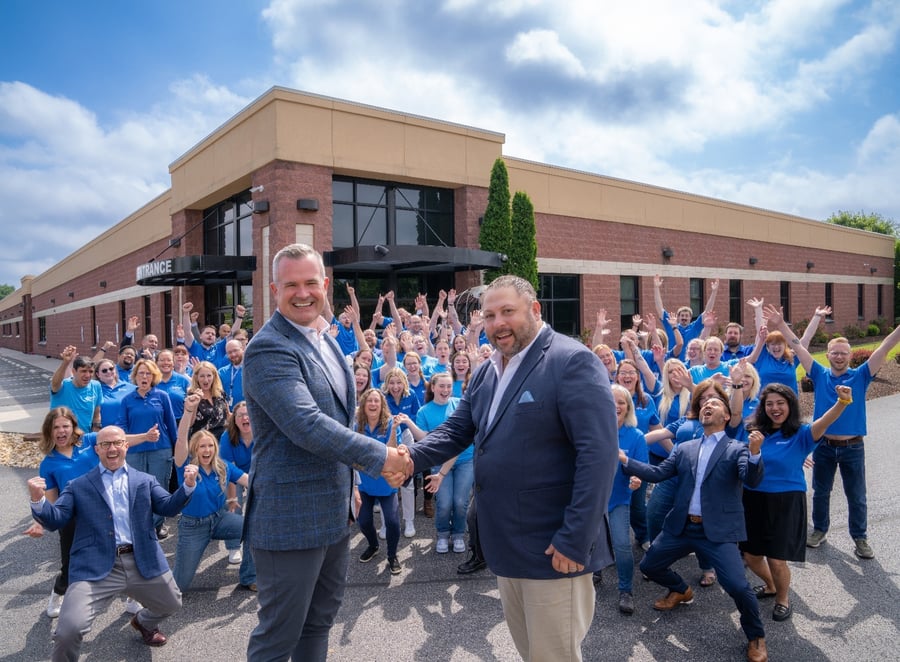
IV Labs acquires Pure Laboratories, Combining Unique Capabilities for Precision Manufacturing
Sep 2, 2025
2 min read
CHRISTIANSBURG, VA --- (JULY 10, 2024 )---Two privately held specialty chemica.
.png?width=900&name=Pure%20Email%20Header%20(1).png)
Introducing Pure Laboratories: Precision, Purity, and Innovation
Mar 3, 2026
1 min read
At Pure Laboratories, precision isn’t just a principle — it’s the foundation o.