
Few inorganic compounds carry the industrial weight of chloroplatinic acid. From the silicones coating the seals in your car to the hydrogen fuel cells being developed for clean energy, the thread running through much of modern platinum chemistry is this single, remarkably soluble salt. Understanding what it does — and why purity matters so much when using it — is essential for anyone working in catalysis, materials science, or precious metal processing.
Where Chloroplatinic Acid Does Its Work
The compound's high solubility and ease of conversion into metallic platinum or platinum-based materials gives it utility across a wide range of industries. Its five major application areas each depend on the same underlying chemistry — but demand very different things from their starting material.
Organic Catalysis & Hydrosilylation
As the active component of Speier's catalyst, CPA dissolved in isopropanol is the workhorse of hydrosilylation — the reaction at the heart of silicone manufacturing for sealants, adhesives, medical-grade elastomers, and electronic encapsulants.
Platinum Purification & Recovery
CPA serves as a key intermediate in extracting platinum from ores, spent catalysts, electronic waste, and recycled materials. Selective precipitation as ammonium hexachloroplatinate allows recovery of platinum at exceptional purity.
Nanoparticles & Electrocatalysts
Through chemical or electrochemical reduction, CPA yields finely dispersed platinum nanoparticles with controlled size and morphology — critical for hydrogen fuel cells, energy conversion systems, and next-generation electrochemical sensors.
Electroplating & Coatings
Platinum deposited from CPA plating baths offers corrosion resistance, high-temperature stability, and superior electrical conductivity on metals, glass, ceramics, and laboratory electrodes and fuel-cell components.
Analytical Chemistry
In the laboratory, chloroplatinic acid functions as a selective reagent for identifying and quantifying specific ions — including potassium (K⁺), cesium (Cs⁺), ammonium (NH₄⁺), and thallium (Tl⁺) — by forming characteristic insoluble complexes. Its precision and reliability in this role depend directly on the purity of the starting material.
"The largest-volume applications are generally associated with hydrosilylation catalyst production for silicone manufacturing and the preparation of platinum catalysts and electrocatalysts used in energy, chemical processing, and environmental technologies."
Specialized & Historical Applications
Beyond its high-volume industrial roles, chloroplatinic acid has found use in several more specialized — and historically significant — areas:
- Decorative finishes: Platinum lusters derived from CPA provide durable metallic coatings on porcelain, ceramics, glassware, and decorative art objects.
- Photography: Traditional platinum printing processes relied on CPA-derived chemistry. Platinum prints are prized for archival stability, image permanence, and rich tonal range — qualities that still attract fine-art photographers today.
- Materials processing: Historically employed in relief etching of zinc printing plates, indelible ink manufacture, and specialized metal finishing operations.
- Microscopy & biological research: Occasionally used as a staining or fixation reagent during biological sample preparation and microscopic analysis.
Why Purity Is Everything
In each of these applications, trace contaminants are not a minor inconvenience — they are a direct threat to process performance. A catalyst synthesized from impure CPA may exhibit unpredictable activity, shortened service life, or batch-to-batch variability that undermines the entire manufacturing process. In analytical chemistry, even parts-per-billion impurities can skew results. In nanotechnology, contaminants influence particle morphology in ways that cannot be corrected downstream.
This is why the purity specification of your chloroplatinic acid source matters as much as any other process parameter. The compound's advantages — high solubility, ready conversion to metallic platinum, compatibility with diverse manufacturing chemistries — are only fully realized when the material itself is rigorously characterized and certified.
Key Properties That Make CPA Indispensable
- High solubility in water and many polar solvents — enabling homogeneous catalyst systems
- Excellent platinum availability for chemical processing at both lab and industrial scale
- Easy, controllable conversion to metallic platinum and platinum nanoparticles
- Compatibility with established catalyst manufacturing processes and electroplating baths
- Utility across refining, electroplating, analytical, and nanotechnology workflows
High-Purity Chloroplatinic Acid, Made to Your Specification
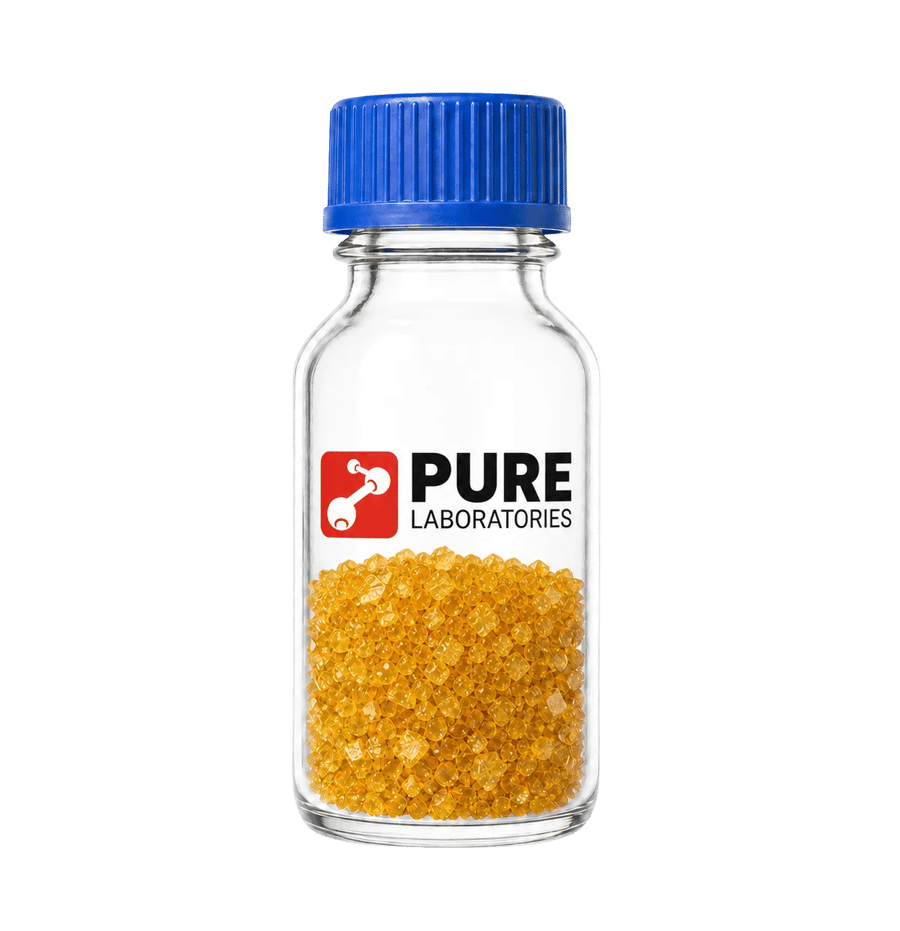
Pure Laboratories manufactures H₂PtCl₆ at purity levels from 99.9% to 99.9995%, with every lot verified by Certificate of Analysis — in-house or via independent third-party laboratories. Custom grades available for research, catalyst production, electroplating, analytical chemistry, and advanced materials applications.